

Average sickness absence days increased in Europe 2006–2020 (1), causing a costly and growing international burden in lost productivity (2). Comparing sickness absence internationally is challenging but taking sick leave is generally perceived to be in the public’s best interest (especially workers with infectious diseases) and serves as a safety net to ensure financial stability for ill employees while recovering (3), given that working whilst ill without necessary work adjustments can exacerbate symptoms (4). However, excessive sickness absence causes adverse impact for the individual (unwanted employment changes; social isolation; increased risk of permanent labor market exit) (5), the employer (disrupted organizational function, co-worker’s workload; productivity loss) and wider society (direct benefit costs and loss of tax income) (1, 6).
For these reasons, understanding risk factors for excessive sick leave is important to develop prevention strategies. However, sickness absence is complex. For example, when examining sickness absence attributed to musculoskeletal pain, more than 30-fold differences in the 12-month prevalence of sickness absence were found among 12 417 workers across 47 occupational groups from 18 countries (7). Even among office workers doing similar tasks, there was a 10-fold variation. Sickness absence rates differ by occupation (8), educational attainment, and ethnicity (9). Another risk factor is gender (7, 10), such that women generally have higher rates of sickness absence than men, with a gap that has been widening over time. Data from Europe 2006–2020 shows an average yearly decrease in costs for absenteeism among male workers (-0.3% each year), but an annual 0.5% increase among female workers (1).
Several theoretical frameworks have been proposed to understand sickness absence and generate hypotheses to understand the gender gap. Researchers argue that individual characteristics, societal influences and workplace factors impact sickness absence differently by gender (10–14). For instance, researchers have increasingly challenged the traditional separation of work and home domains, highlighting the complex interplay between occupational demands and personal life (15). An example of this is the Work–family Conflict Model, grounded in Role-Set Theory and Role Strain Theory (16, 17), which highlights that individuals navigate multiple, often conflicting, roles in the work and family domain, leading to strain. The Role Identity Model further expands on this, suggesting that identification with work and family roles influences one’s experience of conflict or balance, providing a hierarchy of priorities (18). Others propose that sickness absence can be primarily understood through a health perspective (19). A recent global study reported that generally, women tend to live longer than men but face higher levels of illness throughout life, including back pain, depressive disorder and headaches (20). Similarly, others argue that sickness absence could be attributed to women’s health (gynecological and reproductive health) (19). The reasons for gender differences have been the subject of conside rable debate, with researchers formulating a range of hypotheses. Therefore, given the growing focus on gender differences in sickness absence (21, 22) and the rapid growth of a complex body of literature, this paper aimed to conduct an umbrella review to synthesize the evidence underpinning existing hypotheses about gender differences in sickness absence from reviews and meta-analyses. The purpose of this umbrella review was to provide a clear overview of hypotheses rooted in existing literature and to identify gaps in knowledge to address in future research.
Methods
This umbrella review followed PRISMA guidance for conducting systematic reviews (23) and the Joanna Briggs Institute (JBI) methodology for umbrella reviews (24). The protocol was registered with the International Prospective Register of Systematic Reviews (PROSPERO number: CRD42024570174)). One amendment to the original protocol was made regarding how the data was synthesized (see below).
Search strategy
Systematic searches were conducted in July 2024 and updated in October 2025 across seven electronic databases (Embase, MEDLINE, Global Health, PsycINFO, Scopus, Web of Science, and ProQuest). Supported by a librarian, the research team collaboratively developed a search string. Reference lists of included reviews were also searched. Articles identified from the search were screened against predetermined eligibility criteria (supplementary material, www.sjweh.fi/article/4321, appendix A).
Inclusion criteria
Reviews and meta-analyses were eligible for inclusion if articles reported on the exposure ‘gender’, the outcome ‘sickness absence’ and the eligible study design ‘review’, but the primary focus did not have to be sickness absence or gender differences. All peer-reviewed reviews (systematic, narrative, rapid, scoping) and meta-analyses were eligible, provided a systematic search for published articles in electronic databases was used. Umbrella reviews were excluded to reduce over-interpretation of the findings from the original studies. Reviews conducted in English, Dutch, Norwegian or Swedish were eligible. No time-period or country limits were imposed. Grey literature was excluded. Authors were contacted if full-texts could not be retrieved, but reviews were excluded if full-text was not provided.
For the umbrella review topic, it is critical to acknowledge the distinction between sex and gender. Sex can be defined as the biological categorization of males and females based on their reproductive mechanisms (25). Whereas gender is argued to be a social identification construct of either being a man or a woman, portraying masculinity or femininity, irrespective of reproductive organs. The umbrella review aimed to cover hypotheses spanning research that used ‘sex’ definitions for study samples (eg, health hypothesis), but also articles which focused on the social constructs of sickness absence and implemented ‘gender’ definitions (eg, attitudes and norms). Therefore, both definitions were included in this review.
Screening
After searching, reviews were imported to EndNote and Covidence for eligibility screening; duplicates were removed. Given the breadth of the topic and the anticipated volume of reviews yielded, OpenAI (ChatGPT) was used to assist in the screening and basic data extraction processes following published guidance (26) (see supplementary appendix B for full methodology). AI was used to support the human reviewers, not replace judgment. Information relating to hypotheses about sickness absence gender differences was extracted manually by four reviewers from the research team.
Quality assessment
After the full-text screening phase, all eligible reviews underwent quality assessment. The Critical Appraisal Skills Programme (CASP) Systematic Review Checklist (27) was used to assess the quality of each review. The quality assessment was carried out by human reviewers and supported by OpenAI. The human reviewer provided the CASP questions and the full article to the AI platform, and the human reviewer then reviewed and cross-referenced the completed quality assessment. A second reviewer independently assessed the quality of 10% of the articles to assess interrater reliability. Reviews were not excluded based on the quality; instead, the quality of existing reviews is reported.
Data synthesis
A narrative synthesis was planned, given the heterogeneity of the aims and methodologies used in each review. The original aim was to extract researchers’ hypotheses from existing reviews and meta-analyses to critically appraise the supporting evidence, but many retrieved reviews did not include a hypothesis. To account for this, the published protocol was modified so when an a-priori hypothesis was stated, a deductive framework was used to guide analysis. When no hypothesis was stated, an inductive process was used to identify emerging hypotheses.
Initially, the research team developed a framework (table 1), including six sickness absence paradigms: (i) work–family conflict, (ii) gendered health, (iii) work factors, (iv) attitudes and norms, (v) health beliefs, and (vi) barriers to return to work (eg, return to work interventions).
Table 1
Framework for deductive analysis of reviews or meta-analyses with stated a priori hypotheses
| Hypothesis | Description | Hypothesis supported? |
|---|---|---|
| Work–family conflict | Women often face greater demands in balancing work and family responsibilities, which may increase stress and lead to higher rates of sickness absence (15) | Review findings were mixed (N=8). Some articles found increased rates of work–family conflict for women, but men also reported experiencing work–family conflict. |
| Health | Biological factors such as reproductive health issues and other gender-specific vulnerabilities may lead to more frequent or prolonged sickness absence in women (20, 166). | Findings were mixed (N=94), with both genders taking more sickness absence comparatively for health conditions compared to ‘healthy’ comparison groups. There was more of a focus on women’s reproductive health on sickness absence than men’s reproductive health. |
| Work factors | Women may experience poorer working conditions, including bullying, harassment, fewer job opportunities, and higher emotional labour, contributing to sickness absence (160–162). | Both men and women were reported to experience increased sickness absence due to work factors (N=45), specifically adversities faced at work such as bullying or harassment. |
| Attitudes and norms | Gendered expectations and social norms (e.g., women being more accepting of taking leave) may influence sickness absence (22, 156, 163). | Most reviews provided support for gendered attitudes and norms (N=7). Expectations perceived by men and the role of the ‘male provider’ influenced reduced rates of sickness absence for men. |
| Health beliefs | Differences in perceptions about the benefits of sickness absence such as seeing sickness absence as necessary for recovery, may vary by gender (164). | Limited reviews investigating health beliefs (N=2). However, support that women tend to believe sickness absence was good for health and will allow workers recover and return back to work faster. |
| Barriers to return to work | Women may face more obstacles when trying to return to work, including physical limitations, psychological factors, workplace issues, and lack of support. This also encapsulates return-to-work interventions with the hypothesis that these interventions are not equally effective across genders (165). | There was moderate support from reviews (N=16) with reviews reporting that men return back to work faster following an illness. Further, women utilise time on sickness absence to balance domestic responsibilities so are less motivated to return faster. |
Each included review was categorized by one or more hypotheses either if they explicitly named the hypothesis a-priori or investigated an associated risk factor. For example, a review of gender differences in sickness absence from cancer was categorized under ‘health’. Additional hypotheses identified but not specified a-priori were also extracted. There was an opportunity for the list of hypotheses to increase when new hypotheses were identified.
Finally, included reviews were used to explore whether there were any chronological trends of research topics reviewed and to identify any limitations (eg, quality issues) or gaps in the literature to create a road map for future research.
Results
In total, N=2721 articles were retrieved from searches. After de-duplication (N=397), 2324 eligible reviews remained. After full-text screening, 661 reviews were assessed for inclusion (figure 1). Of these, 133 eligible reviews and meta-analyses, published 2000-2024, were included and are shown in table 2. Reviews included studies conducted mostly in Europe (95%), the United States and Canada. Almost all were systematic reviews (N=103), and 22 conducted meta-analyses. Three were described as critical reviews, one review was a meta-ethnography of qualitative studies, and another self-identified as a meta-synthesis of qualitative studies. Nearly half (N=66) did not use, or report a formal quality assessment tool. Not all reviewers described the study types eligible for inclusion, but among those which did, 94 included quantitative studies only, four included qualitative studies only, and 31 included quantitative, qualitative and mixed-methods studies.
Figure 1
The PRISMA flow diagram demonstrating the process of study selection for the umbrella review of included reviews and meta-analyses (N=133).
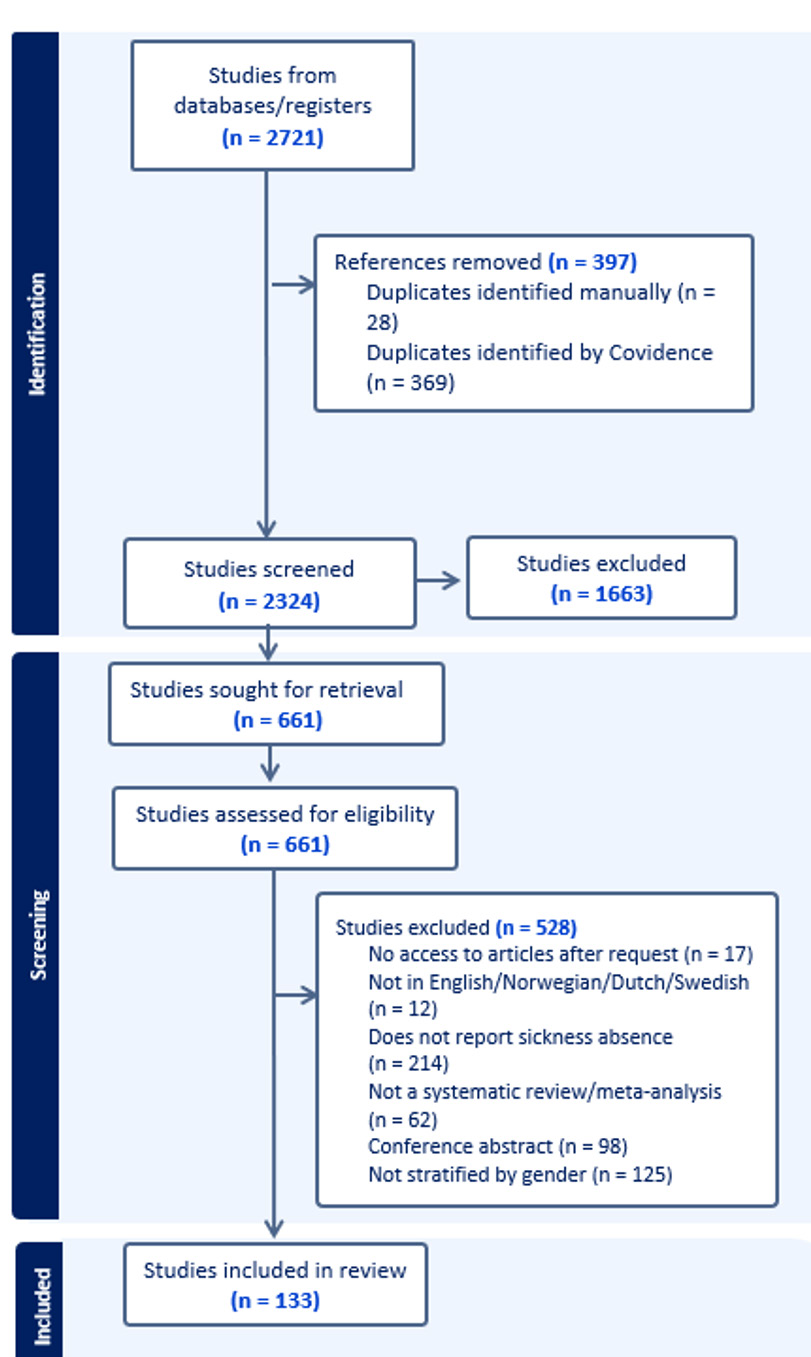
Table 2
Full list of final included reviews and meta-analyses in the umbrella review (n = 133). [MA=meta-analysis; SLR=scoping literature review; SR=systematic review; MM=mixed methods; NR=not reported; QUAL=qualitative; QUAN=quantitative; RTW; return to work; WE=work environment.]
Reviews with a focus on sickness absence gender differences
In total, 12 of 133 included reviews focused specifically on gender differences in sickness absence or explicitly examined one or more a-priori hypotheses (table 3) (28–39). Of these, 7 examined health impacts on sickness absence, mostly women’s reproductive health, including: pregnancy and menopause (31, 33); breast cancer and work (28, 30); menopause (39) and mental illness (36). Work factors and sickness absence were examined in 2 reviews (33, 35), while 1 review investigated the work–family conflict hypothesis (37). Several explored more than one hypothesis.
Table 3
Categorisation of 12 included systematic reviews and meta-analyses where the primary focus was gender differences in sickness absence.
| Reference | Work–family conflict | Work environment | Health | Barriers to return-to-work | Attitudes and norms | Health beliefs |
|---|---|---|---|---|---|---|
| Banning (28) | ✓ | ✓ | ✓ | ✓ | ||
| Bekker et al (29) | ✓ | ✓ | ✓ | |||
| Bijker et al (30) | ✓ | ✓ | ||||
| Brunner et al (31) | ✓ | ✓ | ✓ | |||
| Gjellestad et al (32) | ✓ | |||||
| Henrotin & Gulisano (33) | ✓ | ✓ | ||||
| Hensing et al (34) | ✓ | |||||
| Kausto et al (35) | ✓ | ✓ | ||||
| Körlin et al (36) | ✓ | |||||
| Nilsen et al (37) | ✓ | |||||
| Schou & Moan (38) | ✓ | |||||
| Verdonk et al (39) | ✓ |
The majority (N=11/12) included no information about how sickness absence was defined or measured, and if measured differently by studies included in the same review (37). Most common methods involved employer or national social insurance registries, but self-report studies were included. Under half (N=5) presented any quality assessment, but those that did reported mixed quality. For topics on breast cancer, authors deemed studies to be of high quality (28, 30). Whereas for reviews examining sickness absence and pregnancy, alcohol use or work–family conflict, the study quality was mixed, with most scoring either moderate or low (33, 37, 38).
Can gender differences in work–family conflict explain sickness absence gender differences?
Eight reviews investigated the work–family conflict hypothesis but together found only limited evidence to support it as a cause (29, 31, 33, 34, 37, 40–42). Reviewers highlighted study limitations, including measuring work–family conflicts at only one time point (37).
One review (37) found evidence of a moderate association between a range of work–family conflict measures and sickness absence among women. However, study findings were inconsistent, with others reporting no associations or associations stronger for men (37, 34). Generally, women scored significantly higher for perceived work–family conflict and family–work conflict compared to men, perhaps reflecting gender-different experiences of work–family conflict, which could affect sickness absence.
None of the hypotheses – pregnant women would have more work interruptions if they had several children (31); women may experience additional stress because of their multiple roles (work and home) (42); the combination of work–family conflict and health issues could influence long-term sickness absence; or the greater domestic responsibilities borne by women could limit their ability to fully rest and recover whilst sick leading to longer sickness absence spells compared to men (40) – were supported by evidence.
Can gender differences in health problems explain sickness absence gender differences?
Most reviews focused on health and sickness absence (N=94), generally with mixed findings (28–34, 36, 38–40, 42–124). Both genders took more sick leave when they had health problems than when they did not. A range of health issues were studied including common mental disorders, musculoskeletal conditions, obesity and overweight, chronic diseases, long-term disabilities, unhealthy behaviors (ie, alcohol and smoking), and neurological conditions. Mostly, reviews focused on the health condition and reported sickness absence as a secondary outcome, stratified by gender, without additional exploration or discussion.
Mental health was often examined as a risk factor for sickness absence rather than a potential explainer of gender differences. Most reviews reported mental illness was associated with sickness absence and that mental illness was more common among women than men (34, 42) but did not examine whether the excess prevalence explained gender differences. One review found men who disclosed mental illness were more likely to take sick leave than women (66), and another found no differences between sickness absence rates among men and women with anxiety or depression (90). Alcohol use was a risk factor for sickness absence in both genders (38, 95), but one review found stronger associations between number of alcoholic drinks and binge-drinking, and number of sickness absence days among women compared to men.
Women’s reproductive health and sickness absence were the subject of several reviews, particularly pregnancy. It was postulated that women may be more likely to take sick leave when pregnant than when not pregnant to protect their health and that of their unborn child (31). Another putative explanation was that hormonal changes might impact work participation during physiological menstruation and were exacerbated by menstrual disorders (eg endometriosis) (32). Two reviews suggested higher rates of sickness absence and lower work productivity among women experiencing menopausal symptoms (39, 107). Two reviews reported evidence that endometriosis was associated with higher rates of sickness absence and unemployment (32, 113).
Can gender differences in the work environment explain sickness absence gender differences?
Overall, 45 reviews explored gendered work factors and sickness absence. There was evidence that both genders experienced work adversities (including bullying, aggression, sexual violence/harassment and relational injustice), which were associated with sickness absence (28–31, 33, 35, 36, 41, 43, 51, 58, 68, 71, 72, 75, 80, 81, 87, 100, 103–106, 114, 125–143). One review (135) reported higher rates of bullying among female versus male workers and found an association between bullying and risk of sick leave but did not investigate whether the bullying explained their higher rates of sickness absence. Regarding other workplace adversities, workplace discrimination (perceived as being found less capable) (133), poorer career prospects and opportunities for role mobility were identified among female workers, each of which were associated with sickness absence, but the directionality of these associations was unclear and lengthy sickness absence could directly influence career opportunities for women.
Work-related factors such as physical fitness were measured in relation to sickness absence in one study of police (36). The study found that women generally had higher rates of sickness absence than men, but had higher fitness scores, and fitness score predicted sick leave among men but not women. The authors suggested the historic, masculine nature of the police force and possible tokenism might cause gender differences in sickness absence. Sexual harassment and unequal promotion prospects were associated with worse subjective health, and policewomen were more likely than men to take sickness absence due to career frustrations. Among female blue-collar workers, women had longer durations of sickness absence from musculoskeletal disorders and trauma (68). Mechanisms were not explored, but the reviewers suggested elements of male-dominated environments, such as poor-fitting uniforms unsuitable for female anthropometry and harassment, could contribute.
One review found pregnant women had more sickness absences in workplaces with a higher proportion of female employees compared to workplaces with a higher proportion of males (31).
Can gender differences in attitudes and norms around sickness absence explain gender differences in sickness absence?
Seven reviews explored whether gender differences in attitudes and norms affected sickness absence duration, with the role of the ‘male provider’ considered in several (29, 75, 111, 143–146). Reviewing qualitative evidence (144) showed that men were often the main financial provider, potentially influencing their views about time to return-to-work. However, no evidence was provided that this impacted sickness absence rates.
Beliefs and attitudes among men about work were thought to play a role based on perceived work ethic. It was hypothesized taking sick leave might be perceived as a lack of work ethic, incentivizing male workers to ignore work injuries, especially in male-dominated work environments. One review found male physicians viewed sick-listed male patients as more severely impaired than female patients, whilst female physicians considered men and women equally work impaired or women were more impaired (146). However, the medical indications for sick leave were unreported, which may influence the findings.
Can gender differences in health beliefs about sickness absence explain gender differences in sickness absence?
Two reviews explored the role of health beliefs on sickness absence to explore gender differences (28, 31). Among breast cancer survivors, women felt returning to work following sickness absence was good for their health, and holding this belief encouraged women to go back to work faster (28).
Can gender differences in barriers to return-to-work explain sickness absence gender differences?
Prolonged sickness absence can be caused by barriers to successful return-to-work after illness (28, 35, 51, 84, 87, 96, 103, 112, 134, 147–153). Overall, reviews which reported on the duration of sickness absence found men returned to work faster than women. The evidence does not suggest men recover faster, but rather there may be differential barriers to returning between genders. Examining return after a workplace injury, one review found female gender was a risk factor for poor return-to-work outcomes (134, 151). The authors suggested domestic responsibilities prevented women from giving full attention to recovery. Another explanation may be levels of support provided for return-to-work: after breast cancer treatment, women reported wanting to return for a sense of structure and belongingness, but appropriate adjustments were not provided, and some women met with hostility on their return (28). Men were more likely to be offered vocational rehabilitation (VR) than women according to one review (134), however the industries to which workers were returning were unreported, an important omission, given VR is more often available for white-collar male-dominated industries. Examining partial sick leave as an intervention to facilitate rates of return-to-work, a review found most recipients were women (35).
Other hypotheses
Few included reviews could not be categorized by the pre-defined framework. However, some reviews explored gender alongside other demographic factors, adopting an intersectional approach (31, 56, 73). For example, race differences were found among women taking sick leave following a breast cancer diagnosis, such that 44.4% of black women took sick leave compared to 25.8% of white women (25.8%) (56). However, there were probably considerable confounders caused by inequalities in diagnoses and treatment. Higher educational attainment was found to be associated with increased sickness absence among women (31, 73). However, educational attainment is importantly associated with occupation, with likely effects on sickness absence rates. This intersectionality was also highlighted in a review showing the relationship between diagnosed alcohol misuse and duration of sickness absence was greater among women with lower incomes (38).
Trends in research
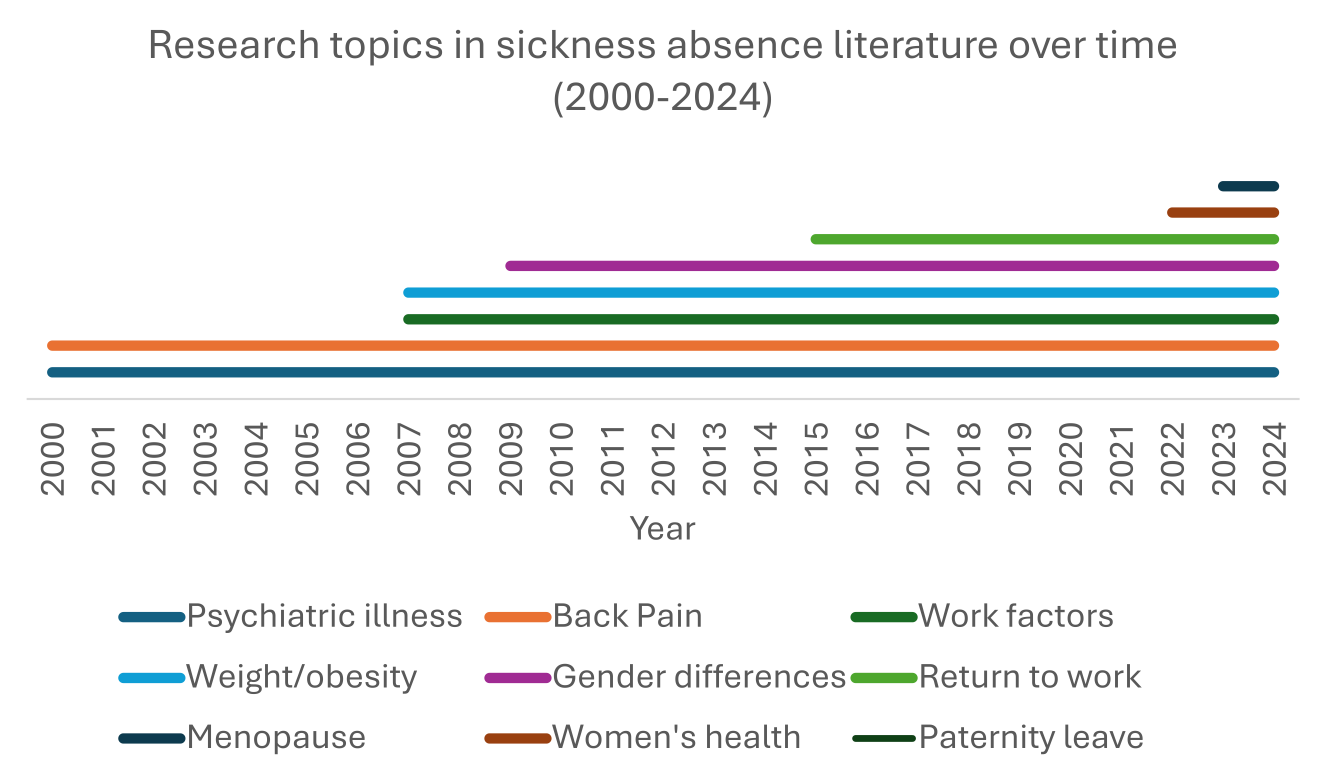
Our umbrella review revealed some chronological changes in the sickness absence literature (figure 2). Between 2000 and 2006, most reviews focused on health issues in the workforce, specifically back pain and mental illness in relation to outcomes including sickness absence and its economic consequences. Reviews published from 2007 focused more on the impact and experiences of workers, and from 2009 started to report gender disparities. Return-to-work reviews were more prevalent in 2015 and 2019, focusing on the proportion of employees on sick leave who returned to work and the duration of sickness absence. Previously under-researched topics including menopause, women’s reproductive health (eg, endometriosis) and paternity leave, started to be published from 2022.
Discussion
This umbrella review identified 133 eligible reviews, only 12 (9.5%) of which specifically focused on gender differences in sick absence. There was a major emphasis on health (N=94) or work environment factors (N=45) for review topics. In contrast, other hypotheses: the role of work–family conflict (N=8); attitudes and norms around sickness absence (N=7); support to return to work after illness (N=16); and beliefs about health (N=2) were understudied. Only around half of the reviews (N=68) published a quality assessment of their included papers. When quality assessment was reported, papers were mostly rated as medium- or low-quality. Although there were some better-rated papers in specific areas, this finding emphasizes a need for better quality research on this topic. Overall, despite an extensive number of relevant reviews, the underlying reasons for gender differences in sickness absence remain inadequately explained.
The literature focused primarily on the role of health, particularly women’s health issues (31, 33, 39), as a cause of gender differences in sickness absence. However, they did not provide compelling evidence that women’s health alone explained the observed gender differences. Where sickness absence was explored across a wider range of health conditions, it was often reported as a secondary outcome, leaving reasons for differences unexplored. A surprising lack of reviews focused on sickness absence for conditions that are exclusive to, or more prevalent among, men such as prostate cancer or cardiovascular disease. It is plausible that gender differences might be attributable to male behaviors and beliefs and, for example, men may underutilize sickness absence because of established stigmas or societal norms, leading to presenteeism, with possible consequences for long-term health (154). Men may be more likely to normalize or ignore injuries at work to improve their perceived credibility or in the belief that taking sickness absence detracts from their masculinity and role as the financial provider (155). Researchers using case studies of men and women experiencing depression found men were less likely than women to view sickness absence as reasonable (22). However, another study found no gender differences in attitudes to sickness absence but found increased tolerance for sickness absence in gender-dominated fields compared to gender-integrated occupations (156). Traditional gender roles might also influence behaviors: women who are traditionally expected to adopt caregiving responsibilities may experience lower levels of perceived and internalized stigma when taking sickness absence for a similar state of health (22). It should be acknowledged that ‘sex’ and ‘gender’ are often used interchangeably in literature, despite referring to distinct biological and sociocultural constructs (25). Future research should explicitly differentiate between these concepts, as comparing hypotheses based on sex with those based on gender could provide important theoretical insights and improve understanding of the mechanisms underlying gender differences in sickness absence.
Given the vast body of literature examining gender in the workplace, we anticipated the included reviews would provide a clearer narrative on how work factors influence gender differences in sickness absence. There was evidence that, compared with men, women were more likely to experience workplace adversities including discrimination, harassment and bullying (135), but not that this differentially affected sickness absence; the risk of which was increased by adversities in both genders (29, 125, 126, 129). It was hypothesized that there may be more sickness absence among women in male-dominated workplaces (36), possibly due to a lack of adjustments accommodating women’s health, but a review of pregnancy-related sickness absence found that absence rates among pregnant employees in female-dominated workplaces were higher than in male-dominated workplaces (31). Taken together, the body of reviews suggested a possible causative effect for a range of workplace factors (policies, physical work demands, psychosocial demands, perceptions about behaviors) but failed to provide clear-cut evidence in support of any.
Our review shows that hitherto, research has focused on observing gendered exposures to risk factors for taking sick leave, laying a broad but fragmented foundation. Consequently, an abundant list of risk factors exists, but without explanatory analysis to understand why these factors cause gender differences in sickness absence. Additionally, investigation of individual single risk factors may be too simplistic if, as is more likely, there is a complex interplay of multiple factors which contribute to gender differences in sickness absence. That women have specific health conditions different from men may be part of the story (although not yet established as a cause) but how they behave in response to symptoms and illness, what healthcare they seek and whether or not they take sick leave are likely to be influenced by their own health beliefs, the culture, beliefs and norms of their community at home and at work. These factors together will influence whether they are well enough to go to work. Clearly, a multi-faceted approach is needed to assess the intersectionality of multiple factors or hypotheses to produce a deeper understanding of the complexities involved and enable implementation of effective prevention strategies.
Strengths and limitations of this umbrella review
A broad search strategy was adopted to capture evidence about the team’s a-priori hypotheses, as well as to identify lesser-known hypotheses. Consequently, approximately 90% of the included reviews were not primarily focused on the gender difference in sickness absence, and sickness absence was frequently measured as a secondary outcome. Few included studies started with an a-priori hypothesis, so reviews were synthesized according to risk factors interpreted through the pre-defined framework. It is feasible the categorization of reviews may have limited our interpretation of review findings. Further, nearly half of the included reviews did not use (or report) a formal quality assessment tool, so it is difficult to ascertain from this umbrella review the quality of evidence.
Despite using a comprehensive search strategy of seven databases, applying no date restriction and including research published in several languages, it is possible we have not captured all relevant reviews. Additionally, it is plausible the search strategy may have captured more reviews on women’s than men’s health because differences in sickness absence are more generally believed to be associated with women’s health, so researchers may be more likely to use the term “sickness absence” in the title/abstract. If so, this highlights a challenge that will need novel approaches from reviewers in future. Further, the inclusion criteria included all types of reviews (eg, narrative reviews, meta-analyses, systematic reviews) in the umbrella review. The heterogeneity of methodological approaches used across review types is acknowledged as a limitation but the aim was to provide a comprehensive overview of all existing evidence that may contribute to hypotheses of gender differences in sickness absence; therefore, inclusion of all review findings was deemed necessary. Similarly, to ensure we included as many relevant hypotheses as possible, reviews on specific women’s health issues, eg pregnancy, were eligible for inclusion as they met the criteria of having an exposure involving gender without a male comparison, which may also have introduced or exacerbated any such bias.
AI was used to screen reviews for eligibility and some basic data extraction. Previous studies have shown high precision at the screening stage for systematic reviews (157) (95%), outperforming human reviewers. However, there is less evidence for the use of AI in umbrella reviews. It is plausible AI might have wrongly rejected reviews, increasing the risk of potential bias. However, at each stage, at least one member of the research team screened all reviews for eligibility to mitigate this risk. Similarly, all included reviews underwent data extraction by researchers, and ‘false positives’ would have been identified at this stage.
The umbrella review highlighted other methodological shortcomings. Methods to measure sickness absence varied and were often inadequately described or critiqued by reviewers. Few reviews examined longitudinal trends in sickness absence. While unexplained currently, exploring temporal patterns may allow us to identify broader cultural shifts, such as changing attitudes towards pregnancy and work, or the medicalization of pregnancy-related symptoms. Additionally, examining sickness absence longitudinally across the life course will enable insights into age-period-cohort effects which may influence (eg menopause) sickness absence.
We found disappointing levels of evidence supporting the common hypotheses used to explain gender differences in sickness absence. Some key priorities for future research include exploring the double burden for women (ie, homemaker responsibilities versus work demands). Although measurement of work–family conflict might partly capture this construct, there were limited reviews on this topic with inconsistent findings. Recent primary studies not yet captured in systematic reviews suggest some associations between work–family conflict and sickness absence, but do not currently provide evidence suggesting differential effects by gender (158, 159). It is plausible current methods to measure work–family conflict are inadequate, and measurement once (37) or only in one direction (ie, work–family conflict and family–work conflict) is masking an effect. It is also possible existing measures capture only practical burdens, but not psychological burden which may impact genders differently. Future studies should aim to comprehensively measure all facets of work–family/family–work conflict using reliable, longitudinal measures (37).
Our review identified a significant gap in the role of health beliefs and gender inequalities on sickness absence (160–165). For instance, variations may exist in taking sick leave to mitigate personal occupational hazards, subjective assessments of work capability, and/or perceived symptom severity. Studies could usefully explore gender differences in health beliefs and intentions of individuals who are considering taking sick leave, currently on sick leave or in the process of returning to work. Another important aspect would be to capture gender differences in motivations to (re-)enter the labor market. Understanding these could provide valuable insights into attitudes towards sickness absence and its underlying determinants.
Concluding remarks
There is currently insufficient evidence to explain gender differences in sickness absence. Despite numerous hypotheses, many of which have strong face validity, there was limited rigorous evidence to underpin these. Partly, this can be explained by the fact that gender differences in sickness absence were addressed only tangentially in many identified reviews. Our findings suggest researchers need to take a cautious approach to avoid conflating plausible hypotheses with established explanatory evidence.
We also found important biases in the evidence, with much of it focused on women-specific health factors (166), including pregnancy and menopause, and limited attention on men and their health and work, effectively preventing a full picture of how gender influences sickness absence. Together, these findings highlight the need for a more focused and theoretically informed research agenda which moves beyond the identification of gendered risk factors, implementing an exploratory approach to causality to robustly investigate the mechanisms by which gender affects sickness absence.