

Labor market affiliation (LMA) after military deployment into war zones is an area of concern as military deployments may affect LMA (1–5) and poor LMA may be related to additional distress, mental health problems (6, 7), mortality (8), and societal costs (4). Yet little is known regarding formerly deployed soldiers’ (FDS) dynamic transitions between employment, unemployment, and long-term sickness absence (LTSA) in the years following their homecoming. To date the dynamic transitioning from employment to LTSA has been researched in a single study (3).
Military deployments may affect LMA both positively and negatively through psychological or physical damage, professional experiences, and social recognition or stigma. Indeed, a substantial proportion of FDS may develop post-traumatic stress disorder (PTSD) and depression (9, 10). Several studies have considered the effects of these conditions on LMA in military populations, with findings suggesting lower work-ability (11, 12), more unemployment (12–16), and missed working days (17). In the general population, PTSD and depression have also been linked with increased risk of layoff (18) and slower return to work after long-term sickness absence (LTSA) (19). However, other studies have suggested weak or non-existent associations between PTSD and depression and LMA outcomes (12–14, 18, 20). Other negative effects of deployment on LMA have been found due to physical disabilities (2, 21) or through social stigma that may follow being involved in specific wars (eg, Vietnam) (1, 22).
Nevertheless, the selection, training, and experience that accompany military careers may also facilitate successful LMA. Indeed, soldiers undergo a dual selection process that involves a voluntary choice to enlist and be deployed and the military procedures of including only those with good physical and mental health (1, 23, 24). Furthermore, soldiers receive military training and obtain a specialized skillset and associated experience, which may be recognized by employers and thus promote a positive LMA (1, 5, 25). Other factors to consider are older age, which has been related to improved LMA (2, 16, 20) or the effect of greater formal education, the impact of which is not as conclusive (1, 14, 16, 20). Finally, the era of the war (eg, Vietnam or post 9/11) may also affect LMA (2, 5, 23, 24, 26), but this may relate to general societal changes and may not be confined to FDS only (2).
Dynamic transitions between labor market states are also common in the general population (27). Therefore, contrasting the LMA of FDS with that of civilians may provide insights into the relative LMA after homecoming. Few studies to date have compared the LMA of soldiers with that of civilians, and only one study compared dynamic transitioning by studying the risk of becoming LTSA or otherwise absent from work in Danish first Gulf War FDS and civilians, without finding long-term differences (3). However, by comparing the chance of being in a specific labor market state, studies from the US have found that soldiers have an increased chance compared with civilians of being employed after completing their service (23, 28). In contrast, younger soldiers specifically (24) and soldiers serving in the US military post 9/11 generally (1) — together with soldiers of Caucasian ethnicity of the Vietnam era but not in the period that followed (5) — have been found to have a higher risk of being unemployed than civilians. Finally, the risk of being unemployed and looking for a job may be higher for combat soldiers or civilians as compared to soldiers who have not been in combat (2); however, no comparison was made between civilians and the combat group in that study.
There are several methodological issues in the literature on LMA for FDS, especially when undertaking comparisons with civilians. First, problems exist with respect to the availability and selection of civilian comparison groups that are equivalent to the soldier populations in terms of being fit for the military and other background factors (23, 28). Second, previous studies have used follow-up periods of different and variable durations [from weeks (28) to decades (3)] during different economic periods (3, 5, 23) or have employed single-point outcome measures (26), all of which may limit the interpretation and comparison of the findings. Third, in relation to differences in deployment experiences only, one study that included a civilian comparison group accounted for the specific country of deployment among the FDS population by including only soldiers deployed to Iraq in the first Gulf War (3). Furthermore, the majority of studies are from the US, where military enlistment and deployments provide access to social and healthcare benefits (1, 24), which in turn may negatively affect the labor market affiliation of military personnel (29). These issues may explain some of the differences found in LMA as FDS and civilians may receive different support.
The aforementioned methodological problems highlight the need to compare FDS and civilians in countries with few differences in available benefits and where high-quality data can be used to match FDS and controls on factors that otherwise may influence LMA. For this purpose, we believe that the present study may provide some advantages as availability of benefits are fairly equal because of the “flexicurity model” (27). This labor market model is characterized by little formal protection, eg, from being laid off, while it provides unemployment benefits or social welfare in most unemployment cases. The free Danish social system also provides companies compensation in most cases of employee LTSA of ≥30 days, and finally education is mostly free and accompanied by an educational support grant from the state (typically ≈USD1000/month). In Denmark, the use of these social benefits is registered and made available for research through Statistics Denmark (30). The access to such data on public payment allows for longitudinal studies across multiple missions and periods and comparisons to be made with a highly selected non-soldier control group. Further, such data allow the consideration of more than the dichotomous labor market outcomes that may provide a static picture of tendencies and instead allow inference based on the dynamic transitioning between labor market states.
The aim of this study was to examine the LMA of FDS after military deployment by comparing the transitions for male FDS within five years of returning from their first registered international military deployment with those of a highly matched general population control group. The transitions studied were from employed to unemployed and vice versa, and between employed and LTSA and back.
Methods
Data
We used data on social transfer payments from the Danish Register for Evaluation of Marginalization (DREAM) together with register data indicating region of residence and highest achieved education (30, 31). DREAM contains weekly information on Danish citizens’ labor market status. From the Danish Defense registers, we used data on conscript board eligibility and age (32) and data from the Danish Deployment Database on deployment country and period (3). All time-dependent data were available in the selection period of 2002–2012 and the follow-up period of 2002–2017. The data were merged via the unique social security number received at birth or when immigrating to Denmark. All data analysis and processing used de-identified data available through Statistics Denmark (30).
Population and matching procedure
Formerly deployed soldiers. Danish army engagement after the year 2001 has been dominated by peacekeeping missions to Kosovo (Kosovo Force), Iraq (Operation Iraqi Freedom), and a more combat-intense counter-insurgency mission to Afghanistan (33) (Operation Enduring Freedom). FDS selected for this study were privates, officers, and non-commissioned officers who had their first-ever registered deployment of ≥28 days to one of these countries in the period 2002–2012, and for whom the region of residence and education at the day of deployment return was known. Conscription is only mandatory for Danish males and, to avoid any bias, we excluded females as their matched control group would consist of only women who volunteered for conscription and thus would not be a random selection of the population. Danish soldiers are employed on either short-term contracts for single missions or temporary contracts, which often terminate at 36 years of age. Therefore, we limited the sample to FDS <36 years of age to avoid bias due to systematically terminated contracts. Military tenure employment or time-limited contracts were generally not accompanied by social or healthcare benefits beyond the general free public Danish social welfare and healthcare systems during the study period. However, as a part of their contract, some soldiers could take civil education courses while they were still employed and paid by Danish defense.
Controls. Controls were selected from a random control population (N=793 625) supplied by Statistics Denmark, ie, individuals without a military deployment since 1992. We included those who were assessed fit for service by the conscription draft board and who had worked ≥6 months in the time leading up to being selected as matches.
Matching period and procedure
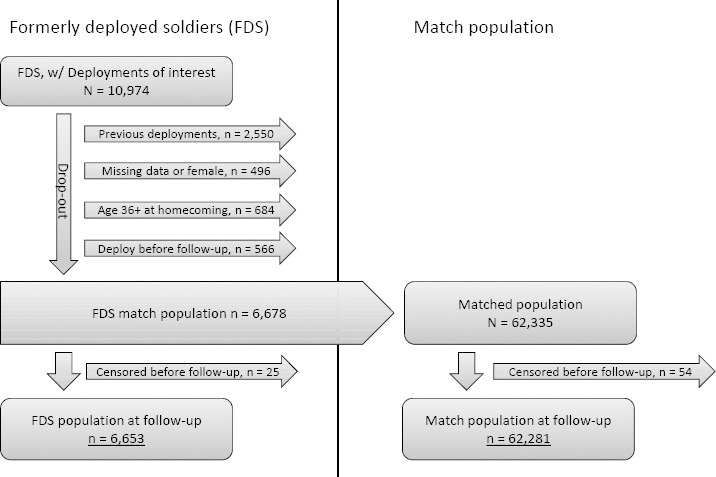
FDS were randomly assigned controls (1:10) using the matching sequence of “calendar half-year”, “region”, “education”, and “age” (see appendix for the procedure, www.sjweh.fi/show_abstract.php?abstract_id=3773). The matching resulted in an average of 9.3 controls per FDS. Six FDS had no matching controls available at the time of homecoming. However, since the actual follow-up time was a time series with changing time-dependent values and, given the large intervals used for the predictors in the final models, their values would eventually fit with other controls; therefore, no adjustments were made. After censoring soldiers in the time between matching and follow-up, 6653 FDS and 62 281 matched controls were available for the analyses. An overview of drop-outs and matches is presented in figure 1.
Follow-up period
The follow-up period started six months after homecoming and continued for up to five years, ie, from 2002 until 2017. The six-month delay was introduced to avoid the initial effect of short-term military contract termination after homecoming (28, 34, 35) and to accommodate changing homecoming procedures during the follow-up period.
Variables
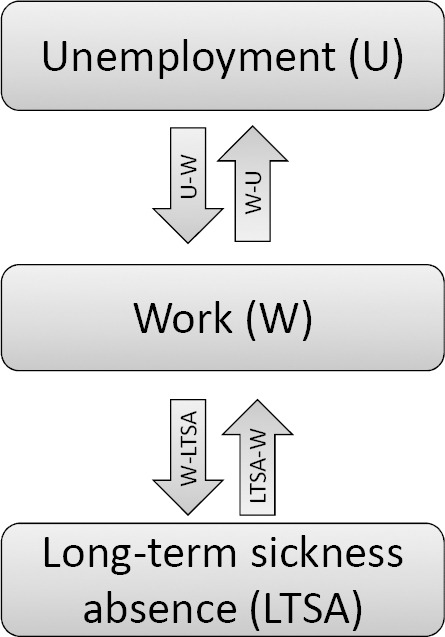
Using the data from the DREAM register, we formulated a model containing the three labor market stages (figure 2): unemployment (U), work (W), and long-term sickness absence (LTSA). Unemployment was defined as periods of receiving unemployment benefits and being available for labor. Long-term sickness was defined as periods of receiving sickness absence benefit for a continuous period of ≥28 days, and work was defined as periods of receiving no social benefits, thereby indicating the individual was self-supporting. For the entire follow-up period, we recorded days the individual spent in each of the three states.
As predictor variables, we constructed a categorical variable indicating deployment status (not deployed/control, Kosovo, Iraq, Afghanistan). We divided age into two groups (18–24 and 25–35 years), grouped yearly data on highest education achieved into low (eg, primary school, high school, preparatory exam) versus high (eg, bachelor’s degree or higher or vocational education) level, and divided yearly information on the region of residence according to the five Danish regions. To adjust for differences across time periods, the follow-up period was divided into intervals composing a categorical variable named “era” that was used for stratification in the models. The four eras were the years 2002–2005, 2006–2009, 2010–2013, and 2014–2017, consistent with trends in the overall net unemployment in the period (36).
All variables, except deployment status, were time-dependent and could thus change throughout the follow-up period. In cases where newer information was not available for the region of residence and highest achieved education, the latest known value was used.
Analysis
The data were arranged in a multi-state model (27, 37, 38) as shown in figure 2. A Cox proportional hazard model was used to analyses each of the four chosen possible transitions, which are illustrated by the arrows in Figure 2: W-U, U-W, W-LTSA, and LTSA-W. All four transitions were recurrent; that is, the same individual could experience them multiple times. We adjusted for such recurrent events using a frailty model (38).
For each of the four analyzed transitions, individuals were censored if they had competing events, turned 36 years of age, received a disability pension, emigrated, had a second deployment, died, or reached the end of the follow-up period. The controls were attached to the matching soldier and were included in the model on the same date six months after the soldier’s homecoming and censored on the same date if the soldier had a second deployment.
All participants were additionally censored with the possibility of re-entering the model if they experienced leave for education, paternity leave, or other kinds of temporary leave from the labor market. The participants were re-included in the analysis whenever experiencing periods of work, unemployment, or sickness absence.
The time axis of the analysis was time in the labor market state. We excluded transitions before six months after homecoming (assigned date for controls) and allowed for late entry. Thus, a person could enter the analysis with a starting time greater than one day. All analyses were stratified by the underlying period (era) and region of residence.
The proportionality assumption was examined using plots of scaled Schoenfeld residuals via the cox.zph procedure of the R survival package (39, 40). Data handling was conducted in SAS (version 9.4), while Cox models were analyzed using the R survival package (version 2.41-3) (39, 40) through R (version 3.4.1).
Results
Descriptive statistics
Sample characteristics at study entry 6 months after homecoming, and matching, are presented in table 1.
Table 1
Characteristics of Danish formerly deployed soldiers (FDS) and matched controls at the start of follow-up.
For an overview of the state proportions, see Appendix (table A1, figure A2, and figure A3, www.sjweh.fi/show_abstract.php?abstract_id=3773). Work proportions were between 71.0–80.8% for FDS and 60.2–80.4% for controls, and both groups experienced a decline throughout the follow-up period. Among FDS, the unemployment proportions in the follow-up period were 2.9–6.2% and 4.2–9.0% for controls. For FDS, unemployment proportions were highest at the start of follow-up, while proportions increased for controls throughout the follow-up period. Long-term sickness absence proportions were relatively constant for both groups at 1.7–2.6% for FDS and 0.9–1.5% for controls. Between 11.0–22.5% of FDS and 14.5–30.7% of controls were in other states in the period (eg, education, disability pension, or temporarily censored). For detailed overview graphs of state proportions for FDS and controls throughout the follow-up period, see appendix.
During the follow-up period, 20.0% of FDS and 28.0% of controls experienced the transition from work to unemployment while 21.8% of FDS and 28.0% of controls experienced the transition from unemployment to work. Further, 9.8% of FDS and 8.0% of controls had a transition from work to long-term sickness absence, while 9.7% of FDS and 6.7% of controls transitioned from long-term sickness absence to work (return to work).
Regression analyses
Risk of becoming unemployed when employed. Compared with controls, FDS had a decreased risk of transitioning from work to unemployment, regardless of whether they were deployed to Kosovo [hazard ratio (HR) 0.73, 95% confidence interval (CI) 0.67–0.79], Iraq (HR 0.73, 95% CI 0.65–0.82), or Afghanistan (HR 0.55, 95% CI 0.50–0.60; see table 2).
Table 2
Results of Cox regression on time in a state before transitioning to another state, for Danish formerly deployed soldiers and matched controls. All models were stratified by region of residence and period/era (2002–2005, 2006–2009, 2010–2013, 2014–2017). [CI=confidence interval; HR=hazard ratio; LTSA=long-term sickness absence; REF=reference level].
| Transition | Work to unemployment | Unemployment to work | Work to LTSA | LTSA to work | ||||
|---|---|---|---|---|---|---|---|---|
| HR | 95% CI | HR | 95% CI | HR | 95% CI | HR | 95% CI | |
| Military deployment | ||||||||
| Not deployed | 1 | 1 | 1 | 1 | ||||
| Kosovo | 0.73 b | 0.67–0.79 | 1.24 b | 1.16–1.33 | 0.89 | 0.77–1.03 | 1.24 b | 1.07–1.44 |
| Iraq | 0.73 b | 0.65–0 82 | 1.31 b | 1.17–1.46 | 1.01 | 0.84–1.22 | 1.11 | 0.92–1.34 |
| Afghanistan | 0.55 b | 0.50–0.60 | 1.19 b | 1.09–1.29 | 1.66 b | 1.46–1.88 | 1.07 | 0.95–1.20 |
| Age group (years) | ||||||||
| 18–24 | 1 | 1 | 1 | 1 | ||||
| 25–35 | 0.89 b | 0.87–0.91 | 0.91 b | 0.88–0.93 | 1.11 b | 1.05–1.18 | 0.91 b | 0.86–0.97 |
| Educational level | ||||||||
| Low | 1 | 1 | 1 | 1 | ||||
| High | 1.51 b | 1.47–1.55 | 1.62 b | 1.58–1.67 | 0.89 b | 0.84–0.94 | 1.17 b | 1.10–1.24 |
Chance of becoming employed when unemployed. FDS who were deployed to Kosovo (HR 1.24, 95% CI 1.16–1.33), Iraq (HR 1.31, 95% CI 1.17–1.46), or Afghanistan (HR 1.19, 95% CI 1.09–1.29) all had an increased chance of transitioning from unemployment to work compared with the controls.
Risk of long-term sickness absence (LTSA) when working. Among FDS, only those who were deployed to Afghanistan were at increased risk of LTSA (HR 1.66, 95% CI 1.46–1.88), while there were no statistically significant differences for FDS deployed to Iraq (HR 1.01, 95% CI 0.84–1.22) or Kosovo (HR 0.89, 95% CI 0.77–1.03) as compared to the control group.
Chance of return to work following LTSA. The FDS who were deployed to Kosovo had an increased chance of returning to work after LTSA (HR 1.24, 95% CI 1.07–1.44), while this was not the case for FDS deployed to either Iraq (HR 1.11, 95% CI 0.92–1.34) or Afghanistan (HR 1.07, 95% CI 0.95–1.20) as compared with the controls.
Discussion
Our study examined the dynamic labor market transitions of Danish male FDS after international military deployment within five years of homecoming from their first deployment. Throughout the follow-up period, FDS had higher work proportions and lower unemployment proportions compared with a highly matched general population control group. Proportions of LTSA among the FDS were slightly higher throughout the follow-up period than among the control group.
We were able to expand on these static results by analyzing the dynamic transitioning among the three states: work, unemployment, and LTSA. The results suggested that FDS with a first-ever deployment to Kosovo, Iraq, or Afghanistan all had a lower risk of becoming unemployed and a higher chance of transitioning from unemployment to work than the control population. To the best of our knowledge, this is the first study to model the dynamic transitions between work and unemployment for FDS, although US studies across eras do suggest that US soldiers leaving the army have an increased chance of being employed (23, 28) and a decreased risk of unemployment (2). Our findings are also consistent with British findings suggesting deployment to war conflict zones does not negatively affect employment prospects (15). Nevertheless, there is also evidence of higher risk of unemployment among post-9/11 veterans (1) and combat veterans of earlier periods (2). Our study extends this research by showing that beyond higher proportions of work and lower proportions of unemployment, FDS who are working have a lower risk of becoming unemployed, and have a higher chance of becoming employed again, compared to an equivalent general population.
When comparing the FDS based on the mission of their deployment, our study indicated that soldiers deployed to Afghanistan were slightly less likely to become unemployed but also slightly less prone to obtain work when they were unemployed, compared to the control population. However, there were no statistically significant differences between FDS with regard to country of deployment (results not shown). Previous studies have suggested that FDS with physical and mental health problems leave the military earlier, and they have higher proportions of unemployment or part-time work, both in the short- and long-term (12, 13, 15, 20, 41–43). A British study found that younger FDS with injuries may be retained for a longer period in the army (21). Nevertheless, while deployment to Afghanistan has generally been considered the most combat-intensive Danish deployment (33), we do not know if any slight differences found may be related to differences in deployment experiences or physical or psychological problems. Future studies should thus seek to account for such factors when studying differences in LMA.
FDS with an Afghanistan deployment had an increased risk of LTSA when working compared to the controls. Pertaining to the peacekeeping missions to Kosovo and Iraq, the results on LTSA are consistent with previous Danish results on FDS of the first gulf war, who did not have a higher risk of LTSA within the 12 years post-deployment (3). However, the results concerning FDS deployed to Afghanistan may be related to the retention of wounded soldiers in the Danish defense force, similar to that reported in the UK (21). In 2011, on the basis of soldiers returning wounded from the Afghan war, Danish defense created systems to formally retain some of the wounded FDS in the military. In these systems, soldiers who were unable to work would generally be categorized as LTSA when they were too sick to work, since Danish defense would collect LTSA compensation. We cannot exclude the possibility that the system instituted in 2011 affected how systematically LTSA compensations have been collected; the system may have affected LTSA proportions slightly. Nevertheless, sick FDS would in most cases be categorized as LTSA if they were too ill to work or apply for work. Based on this, in combination with the higher risk for FDS deployed to Afghanistan for transitioning from work to LTSA that suggests a strong effect, we suggest that the results overall reflect an actual increased risk of LTSA, independent of being retained in the Danish defense force. Finally, FDS deployed to Kosovo were the only group with an increased chance of returning to work after LTSA.
Based on previous research suggesting that FDS of Kosovo could be the least affected with regard to mental health (33), in combination with possible selection and training effects (1, 23, 24), this pattern may be explained by “a healthy worker effect” pertaining to the soldiers (15).
Strengths and limitations
A major strength of the study was its exclusive use of Danish data depositories, which allowed objective information to be gathered (3, 30–32). Further, the access to a large control population allowed us to select a highly matched control group based on several key variables, thus limiting bias/differences between FDS and the control population. The detailed data further allowed us to set equal follow-up times based on exact dates and base our study on the specific early timeframe from the day after homecoming to exactly five years later, while accounting for characteristics of the underlying era.
However, the study has potential limitations. First, we were limited by the use of data on social transfer payments. Given the high availability of transfer payments, the “working” state was defined as receiving no payments (27). This does allow for misclassification in cases where persons are not working but also not receiving any transfer payments (27). Further, we did not account for yearly variation in the job-market. However, we believe this would have affected the model only slightly, due to the close date-matching of FDS and controls. Moreover, as mentioned earlier, we did not account for physical or psychological damage to the deployed FDS, which may have affected their retention in the army. However, as discussed above, physical and psychological illness will generally be categorized as LTSA. Finally, due to the inclusion procedure, our study sampled only men. Given that female FDS may experience a higher employment penalty than men (1), we cannot exclude the possibility that Danish females would have different outcomes than the males in our study.
Concluding remarks
We found that Danish male FDS fared well in the labor market after their first ever deployment, independent of where they were deployed, as evidenced by their lower risk of becoming unemployed and higher chance of becoming employed again if unemployed within five years as compared to the general population. We also found that soldiers who were deployed to Afghanistan, which was associated with the most difficult combat exposure, had an increased chance of LTSA from work compared to the general population. Further, FDS of the Kosovo war had a higher chance of returning to work from LTSA.
Overall our results show that formerly deployed soldiers, in general, are successful in the labor market in the five years after military deployments. However, the minority of those deployed to Afghanistan who experienced LTSA when working did so faster than those in the general population. This suggests that contemporary strategies concerning treatment and rehabilitation initiatives for veterans should consider the specific patterns of deployment and increase focus on veterans returning from Afghanistan who are experiencing LTSA.


