

As the population in most developed countries ages, governments are seeking to increase the proportion of the population in work (1). Due to health-related exclusion from paid employment, workers with poor health are more likely to lose their jobs (2). A meta-analysis showed that self-rated poor health was a risk factor for disability benefit (relative risk (RR) 3.61), unemployment (RR 1.44), and early retirement (RR 1.27) (3). Chronic diseases and limitations in daily activities also have been found to increase the likelihood of exit from paid employment (4, 5).
A recent study using longitudinal data from seven cohort studies in Finland, France, the UK, and the USA provided evidence for socioeconomic inequalities in the risk of health-related exit from paid employment among older workers (6). Low education was associated with an increased risk of leaving paid employment for health reasons in six out of seven cohort studies. In addition, two studies among Swedish and Finnish workers, respectively, showed an increased risk of disability retirement among lower-educated workers, which was partly explained by unfavorable physical working conditions (7, 8). There is emerging evidence that educational inequalities in the pathways out of employment may arise when higher-educated workers are able to afford more voluntary exit routes, such as early retirement, whereas lower-educated workers have to leave the labor force through other (involuntary) pathways, such as disability benefits and unemployment (2).
National social and economic conditions constitute an important social context that may contribute to socioeconomic inequalities in labor force participation and differences in maintaining paid employment of persons with a poor health. European countries can be classified in five regions based on their social welfare systems; the Northern, Continental, Anglo-Saxon, Southern, and Eastern regions (9, 10). Two European cross-sectional studies found that higher income security and employment protection in the Northern region were associated with lower labor market inequalities between healthy and unhealthy persons than in the Anglo-Saxon and Eastern region (11, 12).
However, most studies used a cross-sectional study design, focused on a single country, or investigated single exit routes (3, 6). There is a need for longitudinal studies across a large variety of countries, addressing not only associations between poor health and exit from paid employment, but also educational differences in the risk of exit from paid employment for those in poor health and in the prevalence of poor health. This important distinction can be captured in the population attributable fraction (PAF), as an integrated measure that takes into account both the strength of association between the risk factor and the outcome as well as the prevalence of the risk factor in the population (13).
In the current study, data were used from a large survey among 25 countries with three years follow-up. The primary aim of the study was to investigate educational inequalities in health-related exit from paid employment through different pathways in five European regions. A secondary objective was to estimate the proportion of different routes out of paid employment that can be attributed to health problems across educational groups in five European regions.
Methods
Study sample and design
Longitudinal data from 2005 up to 2014 were obtained from the European Union Statistics on Income and Living Conditions (EU-SILC). Data were used from the EU-SILC four-year rotating panel, where each year 25% of the sample is recruited and 25% is dropped. Data from 25 EU-countries that participated between 2005 and 2014 were available. Details on modalities of data collection, comparability of data between countries and over time, response levels, and any other question concerning the quality of data are provided by the official EU-SILC documentation, which is freely available at ec.europa.eu/eurostat/web/income-and-living-conditions/overview.
Longitudinal EU-SILC data included 1 159 685 persons from 25 European countries. Persons were selected with available information on self-rated health and employment status for at least two consecutive annual measurements (N=1 149 128). For the purpose of this study, persons aged 18‒57 years at baseline (2005–2013) were selected (N=630 229). Subsequently, only persons who were employed at baseline were selected (N=337 444). This selection captures the workforce that is not at risk in this study to exit paid employment through statutory national retirement schemes. In total, 1 056 779 observations of 337 444 participants were included in the study.
Employment status
Employment status was derived annually from questionnaires and classified into six mutually exclusive categories: employment (employee or self-employed, full-time or part-time), disability (unfit to work, permanently disabled), unemployment, early retirement, economically inactive (fulfilling domestic tasks and care responsibilities, and other inactivity), and other (in military service, student). Based on the self-defined employment status in the first year after exit from paid employment, four different pathways out of paid employment were defined: disability benefits, unemployment, early retirement and economic inactivity. Subjects were censored when they left the labor force due to other reasons (1.0% of the study population).
Health
Self-rated health, suffering from a chronic disease and limitations in daily activities due to health problems at enrolment in the four-year rotating cohort were used. Participants were asked to rate their own general health on a 5-point scale, ranging from “very good”, “good”, “fair”, and “bad” to “very bad”. Those reporting “fair”, “bad”, or “very bad” were defined as having a poor self-rated health (14). The question “Do you have any longstanding illness or health problem?” was used to distinguish between people with or without a chronic illness. Those reporting “yes” were defined as having a chronic disease (15). Participants were asked whether they were hampered in their usual activity by any ongoing physical or mental health problem, illness or disability. Those reporting “ yes, strongly limited” or “yes, limited” were defined as having limitations in daily activities due to health problems (15).
Sociodemographic characteristics
Individual characteristics included age, sex, and education. Subjects were divided into three groups according to their level of educational attainment on the basis of the International Standard Classification of Education (ISCED-97). A high education was defined as higher vocational training or university (ISCED 5-6), intermediate education was defined as higher secondary and intermediate vocational training (ISCED 3-4), and low education was defined as pre-primary education, primary education, and lower secondary education (ISCED 0-2) (16).
European region
The European countries were categorized into five different regions based on the social welfare system (10). The Northern region included Denmark, Finland, Iceland, Norway, and Sweden. The Continental region included Austria, Belgium, France, Luxembourg, and The Netherlands. Germany was not included because it was not represented in the EU-SILC four-year rotating panel. The Southern region included Cyprus, Greece, Italy, Portugal, and Spain. The Anglo-Saxon countries included Ireland and the United Kingdom. The Eastern region included Czech Republic, Estonia, Hungary, Latvia, Lithuania, Poland, Slovakia, and Slovenia.
Statistical analysis
The prevalence of poor health, chronic diseases or limitations in daily activities due to health problems at enrolment as well as the incidence of exit from paid employment through different pathways during follow-up, were calculated stratified by the three educational groups and the five European regions. Relative inequalities in the prevalence of health problems as well as relative inequalities in the incidence of exit from paid employment between lower and higher educated workers were analyzed with the R package rateratio.test (cran.r-project.org/web/packages/rateratio.test/rateratio.test.pdf)
The association of poor health with different pathways out of employment was analyzed with a Cox proportional hazards model with censoring of competing events (17–19). Censoring of competing events was done because poor health is a risk factor for most pathways out of paid employment and these pathways compete with each other. For example, receiving a disability benefit (which requires health problems in order to be eligible) is an event typically taking place earlier in life than early retirement, which results in healthier workers exiting paid employment via early retirement (17). Workers from each specific exit pathway were compared with all other workers (ie, those who stayed in paid employment, but also those who left through other pathways). Each separate pathway out of employment was successively the event of interest, hence the other pathways out of employment were then seen as competing events (eg, when disability was the event of interest, unemployment, retirement and becoming economically inactive were the competing events). The associations between poor health and exit from paid employment were adjusted for age, sex, year of the baseline survey, and country. Stratified analyses were conducted for European regions and educational groups. Hazard ratios (HR) with corresponding 95% confidence intervals (CI) were calculated as measure of association. Sensitivity analyses were done on the non-stratified population including the interaction terms health×education and health×European region.
The PAF was estimated to quantify the impact of health problems on exit from paid employment. The PAF is the fraction of exit from paid employment that can be attributed to health problems. The PAF combines the association between health problems and exit from paid employment as well as the prevalence of health problems in the population. A PAF close to 1 indicates that the exit from paid employment is almost completely attributed to poor health. A PAF close to 0 indicates that poor health does not account for exit from paid employment in the study population.
The PAF can be defined as the proportion of unfavorable outcomes (exit from paid employment) that would have been prevented if the exposure of interest (health problems) was eliminated from the population. In cohort studies with time-to-event outcomes, the PAF function can be expressed as PAF = 1- {1 – S0(t)}/{1 – S(t)}, where S(t) is the factual survival function, and S0(t) is the counterfactual survival function had the exposure been eliminated for everyone at baseline (20). The R package AFcoxph was used to estimate confounder-adjusted PAF with Cox proportional hazards regression. (cran.r-project.org/web/packages/AF/AF.pdf)
Finally, the number of persons (per 1000 person years) that left the labor force due to health problems was estimated by taking the PAF from the total number of persons that left paid employment (per 1000 person years) for three educational groups in five European regions. All analyses were carried out with the open-source statistical software R (version 3.4.4).
Results
Differences in the prevalence of poor health, chronic diseases, and limitations in daily activities due to health problems were found between European regions. The prevalence of poor health was highest in the Eastern region (30%), whereas the prevalence of chronic diseases and limitations in daily activities was highest in the Nordic region (25% respectively 15%) (table 1).
Table 1
Characteristics at enrolment of workers in five European regions of a rotating panel (EU-SILC) with a maximum follow-up period of three years (2005‒2014).
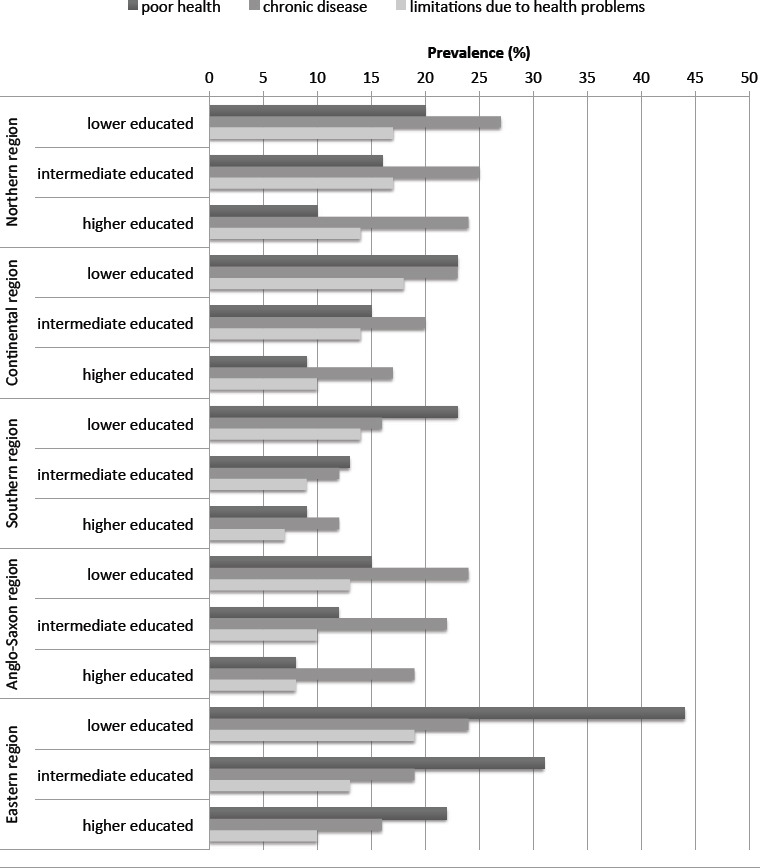
Inequalities in the prevalence of poor health were found between lower- (15–44%) and higher-educated workers (8–22%) in all European regions. In addition, inequalities in the prevalence of limitations in daily activities due to health problems between lower- (13–19%) and higher- (7–14%) educated workers were found. Smaller educational inequalities were found in the prevalence of chronic diseases, with 16–27% of the lower-educated worker having a chronic illness, compared to 12–24% among higher educated workers. (figure 1 and supplementary table S1, www.sjweh.fi/show_abstract.php?abstract_id=3796)
Figure 1
Prevalence of poor health, chronic diseases and limitations in daily activities due to health problems at enrolment among lower-, intermediate-, and higher-educated workers in five European regions of a rotating panel (EU-SILC) with a maximum follow-up period of three years (2005‒2014).
Lower-educated workers more often left paid employment due to disability benefits [3.7–12.8 persons/1000 person years (pyrs)] compared to higher educated workers (1.0–3.9 persons/1000 pyrs) in all European regions. Poor health was an important determinant of exit from paid employment due to disability benefits among all educational groups in all European regions. Poor health was a stronger risk factor of disability benefits among higher- (HR 11.66) than lower-educated workers (HR 6.73) in the Continental region. The fraction of exit from paid employment into disability benefits due to poor health (PAF) was larger among lower- than higher-educated workers in the Northern, Continental, Southern, and Eastern regions, due to a higher prevalence of poor health among lower-educated workers (table 2).
Table 2
The proportion of exit from paid employment into disability benefits that can be attributed to poor health among lower-, intermediate-, and higher educated workers in five European regions of a rotating panel (EU-SILC) with a maximum follow-up period of three years (2005‒2014).
| Level of education | Disability benefits | |||
|---|---|---|---|---|
| Per 1000 person years | Relative inequality (95% CI) | Poor health HR (95% CI) | Population attributable fraction | |
| Northern region | 3.33 (2.50–4.44) | |||
| Lower | 12.8 | 5.36 (3.55–8.09) | 0.49 (0.37–0.61) | |
| Intermediate | 7.4 | 4.44 (3.39–5.81) | 0.41 (0.33–0.50) | |
| Higher | 3.9 | 5.58 (3.73–8.33) | 0.35 (0.24–0.46) | |
| Continental region | 4.30 (3.21–5.80) | |||
| Lower | 6.4 | 6.73 (4.73–9.56) | 0.56 (0.46–0.65) | |
| Intermediate | 3.1 | 7.72 (5.78–10.31) | 0.51 (0.43–0.59) | |
| Higher | 1.5 | 11.66 (7.22–18.85) a | 0.50 (0.38–0.63) | |
| Southern region | 3.58 (2.70–4.83) | |||
| Lower | 3.7 | 3.22 (2.51–4.13) | 0.36 (0.28–0.43) | |
| Intermediate | 1.4 | 4.18 (2.86–6.11) | 0.32 (0.21–0.43) | |
| Higher | 1.0 | 4.48 (2.59–7.75) | 0.28 (0.14–0.42) | |
| Anglo-Saxon region | 4.67 (3.25–6.77) | |||
| Lower | 12.4 | 4.44 (2.79–7.08) | 0.36 (0.23–0.49) | |
| Intermediate | 5.3 | 7.01 (4.80–10.22) | 0.42 (0.32–0.53) | |
| Higher | 2.7 | 7.92 (4.55–13.77) | 0.39 (0.24–0.54) | |
| Eastern region | 6.16 (4.95–7.69) | |||
| Lower | 12.2 | 5.29 (3.74–7.50) | 0.68 (0.59–0.77) | |
| Intermediate | 5.6 | 4.26 (3.66–4.95) | 0.56 (0.52–0.61) | |
| Higher | 2.0 | 5.47 (3.61–8.29) | 0.58 (0.46–0.70) | |
Lower-educated workers also more often became unemployed (32.4–72.9 persons/1000 pyrs) compared to higher-educated workers (12.6–34.8 persons/1000 pyrs). There was no significant difference between educational groups in the strength of the association between poor health and unemployment, but the fraction of unemployment that could be attributed to poor health was higher among lower- (0.05–0.12) than higher-educated workers (0.02 and 0.08) in most European regions, due to a higher prevalence of poor health among lower-educated workers (table 3).
Table 3
The proportion of exit from paid employment into unemployment that can be attributed to poor health among lower-, intermediate-, and higher educated workers in five European regions of a rotating panel (EU-SILC) with a maximum follow-up period of three years (2005‒2014).
Lower-educated workers also retired more often (8.4–15.4 persons/1000 pyrs) compared to higher educated workers (2.1–7.3 persons/1000 pyrs) in the Continental (RI 4.03), Southern (RI 2.11), and Eastern (RI 2.41) regions. A higher fraction of retirement could be attributed to poor health among higher- (PAF 0.11–0.12) compared to lower-educated workers (PAF 0.00–0.01) in the Continental and Anglo-Saxon regions, due to a stronger association between poor health and retirement among higher educated workers in these regions (HR 1.80–2.29) compared to lower-educated workers (HR 0.98–1.03) (table 4).
Table 4
The proportion of exit from paid employment into retirement that can be attributed to poor health among lower-, intermediate-, and higher educated workers in five European regions of a rotating panel (EU-SILC) with a maximum follow-up period of three years (2005‒2014). [NA=not available.]
| Level of education | (Early) retirement | |||
|---|---|---|---|---|
| Per 1000 person years | Relative inequality (95% CI) | Poor health HR (95% CI) | Population attributable fraction | |
| Northern region | 0.74 (0.50–1.06) | |||
| Lower | 4.7 | 0.95 (0.39–2.32) | NA | |
| Intermediate | 5.7 | 1.27 (0.88–1.83) | 0.05 (-0.03–0.13) | |
| Higher | 6.4 | 0.77 (0.46–1.30) | NA | |
| Continental region | 4.03 (3.15–5.20) | |||
| Lower | 8.4 | 1.03 (0.76–1.40) | 0.01 (-0.09–0.11) | |
| Intermediate | 5.1 | 1.30 (1.02–1.65) | 0.07 (0.00–0.14) | |
| Higher | 2.1 | 1.80 (1.14–2.83)a | 0.11 (0.01–0.21) | |
| Southern region | 2.11 (1.89–2.37) | |||
| Lower | 15.4 | 1.14 (1.01–1.29) | 0.05 (0.00–0.10) | |
| Intermediate | 6.4 | 1.08 (0.87–1.33) | 0.01 (-0.04–0.05) | |
| Higher | 7.3 | 1.05 (0.80–1.38) | 0.01 (-0.04–0.05) | |
| Anglo-Saxon region | 0.98 (0.57–1.61) | |||
| Lower | 3.4 | 0.98 (0.34–2.82) | NA | |
| Intermediate | 3.2 | 0.75 (0.37–1.52) | NA | |
| Higher | 3.5 | 2.29 (1.28–4.08)a | 0.12 (0.02–0.23) | |
| Eastern region | 2.41 (2.06–2.81) | |||
| Lower | 13.9 | 1.19 (0.92–1.53) | 0.11 (-0.04–0.26) | |
| Intermediate | 7.3 | 1.11 (0.99–1.25) | 0.06 (0.00–0.11) | |
| Higher | 5.8 | 1.17 (0.94–1.46) | 0.06 (-0.03–0.14) | |
Lower-educated workers (12.3–23.6 persons/1000 pyrs) also more often left paid employment due to economic inactivity than higher-educated workers (8.2–16.9 persons/1000 pyrs) in all European regions, except for the Northern region. The fraction of exit from paid employment into economic inactivity that could be attributed to poor health was larger among lower- (0.09–0.29) compared to higher-educated workers (0.05–0.06) in all European regions, except for the Southern region (table 5).
Table 5
The proportion of exit from paid employment into economic inactivity that can be attributed to poor health among lower, intermediate, and higher educated workers in five European regions of a rotating panel (EU-SILC) with a maximum follow-up period of three years (2005‒2014). [NA=not available.]
| Level of education | (Early) retirement | |||
|---|---|---|---|---|
| Per 1000 person years | Relative inequality (95% CI) | Poor health HR (95% CI) | Population attributable fraction | |
| Northern region | 0.95 (0.75–1.18) | |||
| Lower | 13.4 | 3.41 (2.24-5.21)a | 0.29 (0.17-0.41) | |
| Intermediate | 11.9 | 1.43 (1.09–1.87) | 0.06 (0.01–0.11) | |
| Higher | 14.1 | 1.51 (1.09–2.10) | 0.05 (0.01-0.09) | |
| Continental region | 1.49 (1.27–1.74) | |||
| Lower | 12.3 | 1.46 (1.11–1.92) | 0.09 (0.02–0.16) | |
| Intermediate | 11.7 | 1.50 (1.24–1.83) | 0.06 (0.03–0.10) | |
| Higher | 8.2 | 1.73 (1.30–2.32) | 0.06 (0.02–0.09) | |
| Southern region | 2.18 (1.98–2.41) | |||
| Lower | 20.4 | 1.12 (0.99–1.26) | 0.03 (-0.00–0.06) | |
| Intermediate | 14.7 | 1.06 (0.90–1.24) | 0.01 (-0.01–0.03) | |
| Higher | 9.4 | 1.77 (1.39–2.25)a | 0.06 (0.03–0.09) | |
| Anglo-Saxon region | 1.39 (1.14–1.70) | |||
| Lower | 23.6 | 1.64 (1.08–2.51)a | 0.09 (0.00-0.17) | |
| Intermediate | 18.5 | 1.13 (0.84–1.52) | 0.01 (-0.02-0.05) | |
| Higher | 16.9 | 0.84 (0.56–1.27) | NA | |
| Eastern region | 1.13 (0.99–1.28) | |||
| Lower | 15.8 | 1.41 (1.12–1.78) | 0.13 (0.05–0.21) | |
| Intermediate | 11.5 | 1.14 (1.02–1.27) | 0.03 (0.01–0.05) | |
| Higher | 14.0 | 0.98 (0.80–1.21)a | NA | |
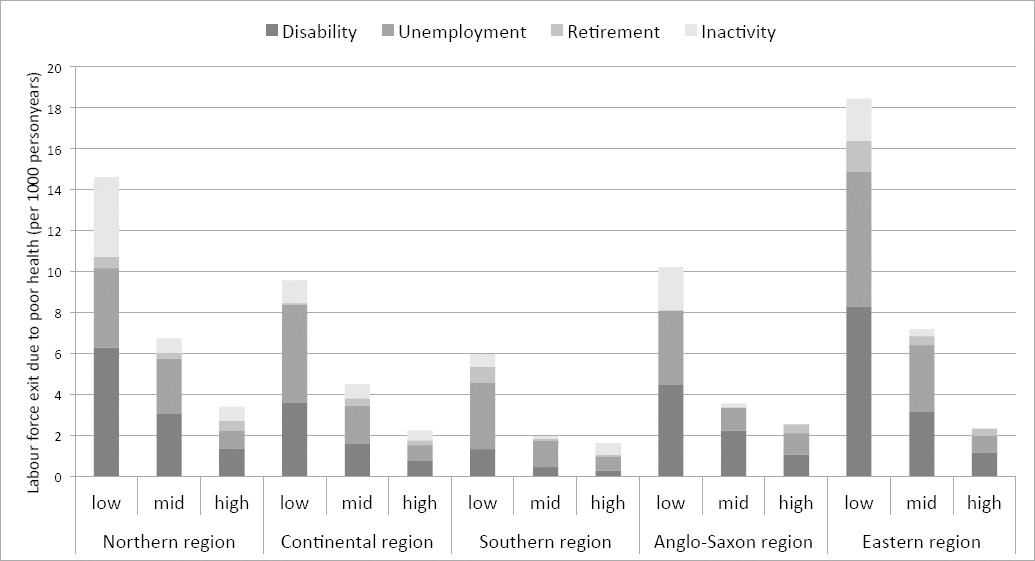
Taking into account all pathways, lower-educated workers more often left paid employment due to poor health (6.0–18.4 persons/1000 pyrs) compared to higher educated workers (1.6–3.4 persons/1000 pyrs) in all European regions. Educational inequalities in displacement from paid employment were largest in the Eastern region where 18 persons/1000 pyrs of lower-educated workers left paid employment due to poor health compared to 2 persons/1000 pyrs among higher-educated workers. In contrast, in the Southern region educational inequality was lowest with 6 persons/1000 pyrs and 1.6 persons/1000 pyrs, respectively (figure 2).
Figure 2
Labor force exit through different pathways due to poor health among lower-, intermediate-, and higher-educated workers in five European regions of a rotating panel (EU-SILC) with a maximum follow-up period of three years (2005‒2014).
In addition to poor health, all analyses were carried out with two other health measures: chronic disease and limitations in daily activities due to health problems. These health measures had similar effects on exit from paid employment through different pathways among lower- and higher-educated workers (supplementary figures S1 and S2, www.sjweh.fi/show_abstract.php?abstract_id=3796).
Discussion
In all European regions, lower-educated workers had higher risks of leaving paid employment due to disability benefits (RI 3.3–6.2) and unemployment (RI 1.9–4.5) than those with higher education. Taking into account all pathways, the fraction of exit from paid employment that could be attributed to poor health varied between the five European regions among lower-educated persons from 0.06–0.21 and among higher-educated workers from 0.03–0.09. The disadvantaged position of lower-educated persons on the labor market was primarily due to a much higher prevalence of poor health, since the associations between poor health and exit from paid employment were equal or even smaller among persons with lower versus higher education.
The PAF can be interpreted as the proportion of exit from paid employment that would theoretically be prevented if the exposure to poor health was completely eliminated. Few studies have calculated the PAF to quantify the impact of health on exit from paid employment (4, 21–23). A European study showed that the PAF of exit from paid employment due to poor health was largest for disability benefits (PAF 0.61), followed by unemployment (PAF 0.27), and retirement (PAF 0.09) among older workers (4). Another study among older workers in the Netherlands provided evidence for the impact of a poor physical health on early retirement (PAF 0.21) (21). However, these studies did not differentiate between educational groups in their estimate of the impact of poor health on exit from paid employment.
In most European regions, the influence of poor health on disability benefits and early retirement was more profound among higher-educated workers, whereas the influence of poor health on becoming economically inactive was more profound among the lower-educated. In general, higher-educated workers have higher wages and thus may face larger income losses due to health problems compared to lower-educated workers. Eligibility criteria for disability benefits based on income loss may therefore be more difficult to meet for lower- compared to higher-educated workers. It has been suggested that higher-educated workers have the financial resources to retire before the statutory age, whereas lower-educated workers have to rely more on statutory pension schemes (21). Recent information from Statistics Netherlands indeed showed that lower-educated workers retire one year later than higher-educated workers (24). Lower-educated workers with health problems may also leave paid employment through other pathways, such as unemployment or economic inactivity, financially depending on unemployment or social benefits.
A recently published study showed that persons with a lower socioeconomic position were more likely to exit paid employment into disability benefits (6). However, educational inequalities in exit from paid employment can be the result of a higher prevalence of poor health among lower-educated workers or a stronger association between poor health and exit from paid employment. The current study showed that educational differences in the prevalence of poor health between lower- (15–44%) and higher-educated workers (8.2–22%) in all European regions were more responsible for higher proportions of unemployment and disability among lower- compared to higher-educated workers than educational differences in the association between poor health and exit from paid employment.
Educational inequalities in displacement from the labor market were largest in the Eastern region and lowest in the Southern region. In the Eastern region, a higher prevalence of poor health resulted in larger educational inequalities in health-related exit from paid employment into disability, unemployment, and economic inactivity compared to the other European regions. In the Southern region, the prevalence of health-related labor force exit through disability, unemployment, and economic inactivity was lower compared to the other regions. During the course of this study (2005–2014), unemployment was higher in the Southern region (10%) compared to other European regions (4–8%) (10, 25). Economic factors may have played a more important role in determining exit from paid employment in the Southern region (26).
Educational inequalities in the prevalence of poor health may be the result of more unfavorable working conditions and unhealthy behaviors among lower educated workers. Two prospective studies in Danish employees showed that two-thirds of the social gradient in self-reported health could be explained by the work environment, such as repetitive work, and lifestyle factors, such as obesity (27, 28). More frequent exposure to physically demanding work among lower-educated workers may result in a higher prevalence of health problems among this group than higher-educated workers (29, 30). In addition, educational inequalities in unhealthy behavior, such as smoking and lack of physical activity, may also contribute to the higher prevalence of poor health among lower-educated workers (31).
Strengths and limitations of the study
This study used the open access data from the EU-SILC. A strength of the current study is the use of longitudinal data from a large number of European countries. The large number of participants allowed to make comparisons between European regions.
Another strength of the study is that, in addition to the “normal epidemiological procedure” of assessing associations between exposure to a risk factor and the occurrence of a particular outcome, in the current study the impact of the exposure to a risk factor (poor health) on the outcome (exit from employment) was also quantified in different educational groups. Although poor health was a stronger risk factor for some pathways among higher-educated workers, it was shown that the proportion of labor force exit due to disability, unemployment, and economic inactivity was higher among lower-educated workers in most European regions, due to the higher prevalence of poor health among lower-educated workers. This information is essential for policy-makers in order to be able to quantify the potential impact of specific measures aimed at the specific risk factor (poor health) in specific populations (lower- versus higher-educated workers).
In the current study, three measures of health (self-perceived health, chronic disease and limitations in daily activities due to health problems) were included. The largest educational inequalities were found in the prevalence of self-perceived poor health. Analyses with these three health measures showed similar results. Therefore, results of one health measure, self-perceived health, were presented. The assessment of self-perceived health has been found to be useful in evaluating health status in large epidemiologic studies and has been shown to be a strong predictor of mortality in high as well as low socioeconomic groups (32). The pattern of self-perceived poor health across European regions was corroborated by another study using data from the World Health Survey, which found a higher prevalence of poor health in the Eastern European region compared to the Central and Western European regions (33).
A disadvantage was the use of self-reported employment status, which may differ from registered employment status and between European regions. For example, non-employed persons may consider themselves as unemployed only when they are actively looking for work, whereas others on unemployment benefits may have categorized themselves as economically inactive. Another example is the difficulty to distinguish illness-based retirement from non-illness based retirement. Some persons with illness-based retirement may have categorized themselves as retired instead of being disabled.